
Good records do more than prove that a contractor visited. They help property managers see whether required work happened, whether deficiencies were identified, and whether those deficiencies were actually corrected. A useful fire-safety record system connects technical service reports to management action.
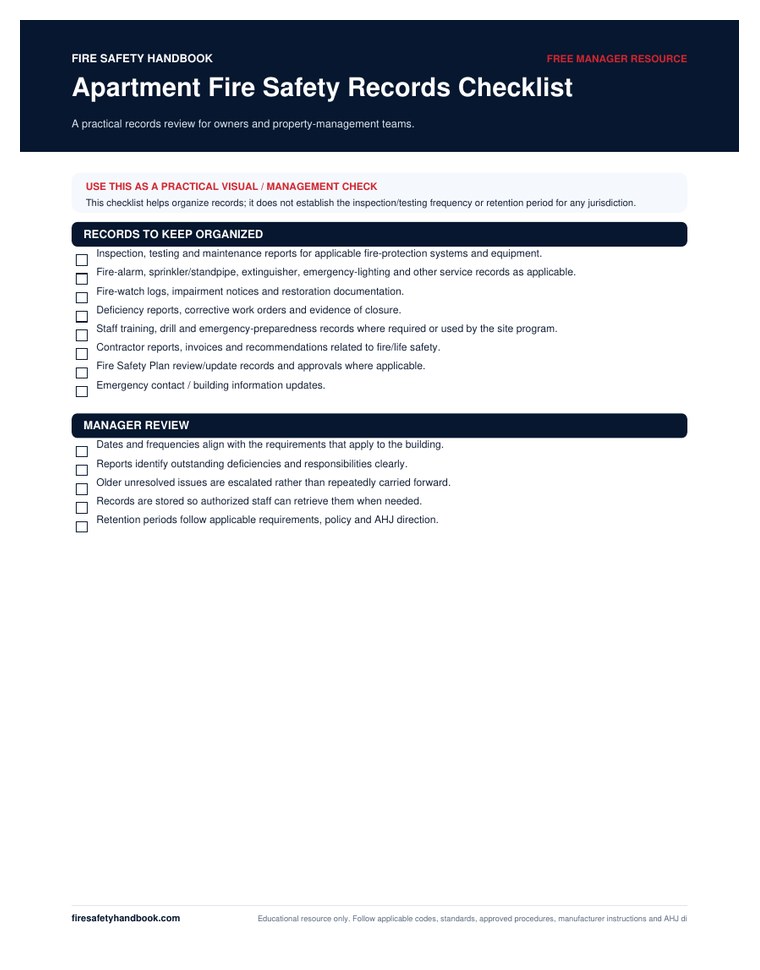
Apartment Fire Safety Records Checklist
A printable records review to help property managers keep service, deficiency and emergency documentation organized.
Keep inspection, testing and maintenance records together
Service documentation for applicable fire alarm, sprinkler, standpipe, extinguisher, emergency-lighting and other fire-protection equipment should be organized so managers can retrieve it. A chronological system makes missed or overdue work easier to spot.
Separate deficiencies from completed service
A report saying an inspection was performed does not necessarily mean the system has no deficiencies. Identify open items, create a correction record and link the completed repair or follow-up to the original issue.
Keep impairment and fire-watch documentation
When systems are impaired, retain the records required by the building procedure and applicable requirements. Fire-watch logs should identify the assigned areas, patrol frequency, observations, actions, start/end times and restoration/authorization details.
Keep staff training and emergency-preparedness records where applicable
If the building program requires drills, training, staff acknowledgements or emergency assignments, keep the records in a predictable location. Managers should be able to tell who was trained, for what role and when.
Review contractor recommendations, not just invoices
Invoices confirm financial transactions; they do not always explain system condition. Keep the technical report, recommendations and any follow-up correspondence needed to understand what was found and what remains outstanding.
Use records to identify recurring problems
Repeated blocked exits, damaged doors, access issues or unresolved service deficiencies can reveal a process problem. Periodic record reviews help managers see patterns that are not obvious from one report at a time.
Frequently asked questions
How long should fire-safety records be kept?
Follow the retention requirements that apply to the building, its Fire Safety Plan, applicable codes/standards, company policy and authority having jurisdiction. This guide does not set a universal period.
Is an invoice enough to prove required service was completed?
Not always. Retain the service/inspection report and any documentation needed to show findings, deficiencies, corrective work and restoration.
Should fire-watch logs be kept after the system is restored?
Keep them for the period required by the applicable building procedure, policy and authority having jurisdiction.