
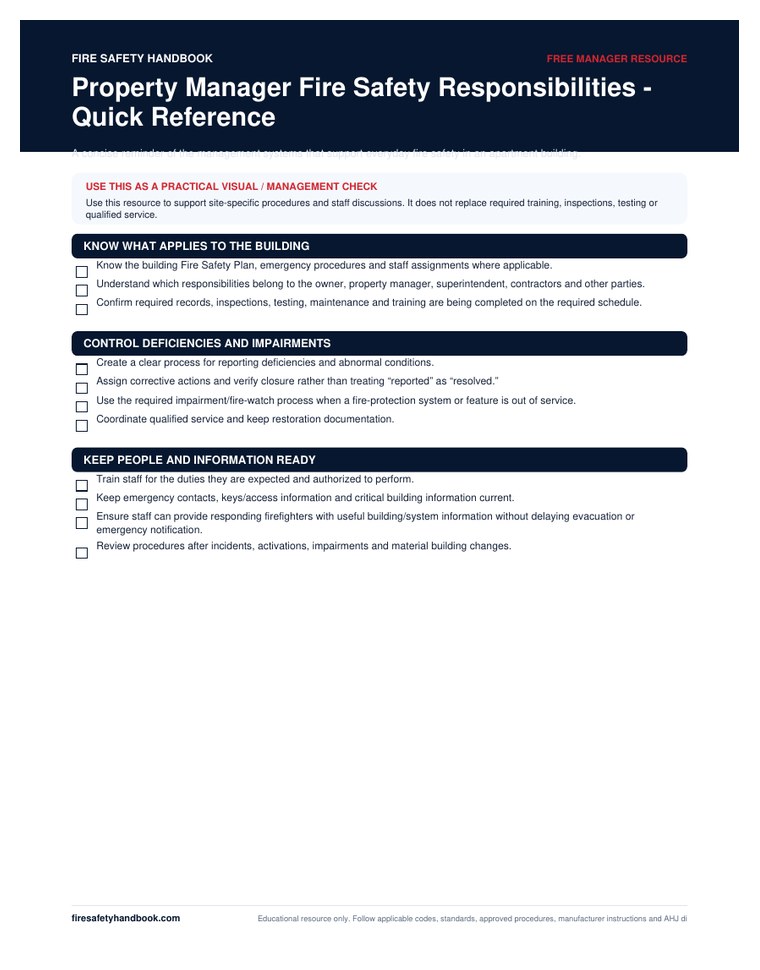
Property managers sit at the point where building ownership, residents, contractors and day-to-day operations meet. Fire safety therefore depends less on one isolated task and more on clear accountability: knowing what applies to the building, assigning duties, coordinating qualified service, keeping records and making sure deficiencies are actually corrected.
Property Manager Fire Safety Responsibilities - Quick Reference
A one-page reference for discussing responsibilities with owners, managers, superintendents and building staff.
Know who controls what
Start with the actual building arrangement. Ownership, property management, site staff and contractors may each control different functions. Leases and management agreements can divide responsibilities, but internal allocation does not eliminate the need to understand and meet the requirements that apply to the building.
Keep the Fire Safety Plan and site procedures operational
Where a Fire Safety Plan or equivalent approved emergency procedures apply, managers should know where the current document is kept, who has assigned duties and how changes are communicated. A plan that staff cannot access or understand has limited operational value.
Coordinate qualified inspection, testing and maintenance
Managers should not turn technical system work into an informal staff task. Use qualified service providers where required, track scheduled work, review reports and make sure access is available. The management role is often coordination, documentation and follow-through.
Create a deficiency-to-correction process
A strong process answers four questions: What is wrong? Who owns the correction? When will it be addressed? How will completion be verified? This prevents inspection reports, emails and contractor recommendations from becoming disconnected records.
Manage impairments and fire watches
System impairments need a defined response. Staff should know how to report the impairment, who decides the next steps, which temporary measures are required, how a fire watch is documented if applicable, and how restoration is confirmed.
Keep staff ready for emergencies
Train staff for the duties they are actually expected and authorized to perform. Emergency contacts, keys, access information and building/system details should be current. Staff should know when to call emergency services and should not delay evacuation or emergency notification while trying to investigate a developing incident.
Review after changes and incidents
Equipment changes, renovations, storage changes, contractor work, system activations and actual incidents are opportunities to review procedures. If building conditions or responsibilities have changed, records and plans should change with them.
Frequently asked questions
Is the property manager personally responsible for every fire-safety task?
Not necessarily. Responsibilities depend on the building, contracts, applicable law and assigned roles. The manager still needs to understand who is accountable for each required function and how completion is verified.
Can building staff perform fire-protection system maintenance?
Only where the task is within their training, authorization and the applicable requirements. Technical inspection, testing, maintenance and repair should be completed by qualified persons where required.
What is the most important management habit?
Closing the loop on deficiencies. A noted problem that is never assigned, corrected and verified remains a problem.