
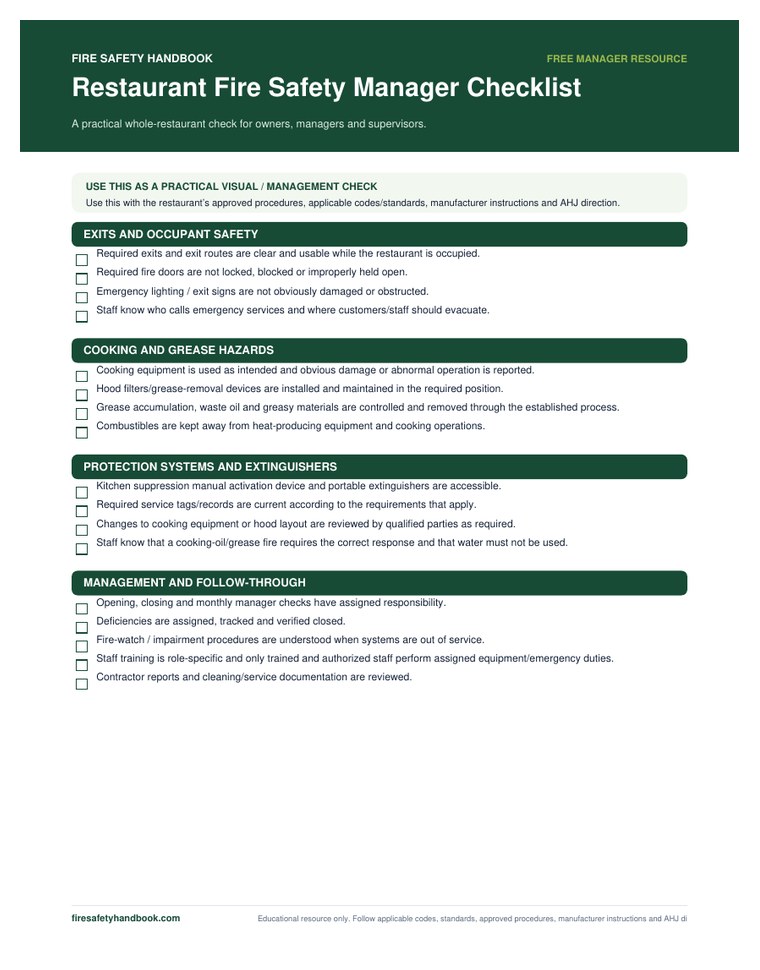
Restaurant fire safety is broader than the hood over the cooking line. Managers need to connect exits, cooking equipment, grease control, suppression systems, portable extinguishers, storage, electrical hazards, staff training, records and emergency response into one operating routine. This checklist is designed to make that routine easier to see.
Restaurant Fire Safety Manager Checklist
A whole-restaurant printable checklist that managers can use to organize recurring fire-safety follow-through.
Start with exits and occupant safety
Before thinking about equipment, confirm people can get out. Required exits and exit routes should remain clear while the restaurant is occupied, required doors should not be locked or obstructed, and staff should know the emergency notification and evacuation procedure.
Control heat, cooking and grease together
Cooking equipment, grease accumulation, combustible storage and housekeeping interact. Managers should look beyond the cooking surface to filters, visible hood areas, waste grease, nearby packaging and anything that can add fuel around heat-producing equipment.
Keep kitchen suppression accessible and matched to the cooking line
The manual activation device should remain visible and accessible. Nozzles and protected appliance arrangements should not be casually altered. Cooking-equipment changes can affect system protection and should be reviewed through the required qualified process.
Make extinguisher awareness role-specific
Staff should identify extinguishers by their rating/equipment label rather than cylinder colour. Class K extinguishers are associated with commercial cooking-oil and grease hazards where required. Only trained and authorized staff should perform assigned extinguisher duties, and evacuation/emergency notification must not be delayed.
Include electrical, battery and storage hazards
Extension cords, damaged plugs, overloaded outlets, battery charging and combustible storage can create hazards outside the cooking line. Charging areas should keep batteries and devices away from heat and combustibles and damaged batteries should be taken out of service through the appropriate procedure.
Use opening, closing and monthly checks differently
Opening and closing checks are short operational scans. A monthly manager inspection can look more broadly at service records, equipment changes, training, recurring deficiencies and contractor follow-through. Each check should have an assigned person and a clear escalation process.
Track deficiencies to closure
A strong checklist ends with action. Record what was found, assign responsibility, set follow-up and verify closure. When a fire-protection system is impaired, follow the applicable impairment/fire-watch process rather than treating the checklist as a workaround.
Frequently asked questions
Does a restaurant fire-safety checklist replace inspections by fire-protection contractors?
No. It helps managers identify operational and visible-condition issues between required professional service visits.
Should every employee use a fire extinguisher?
No. Extinguisher use should be limited to staff who are trained and authorized under the restaurant procedure and only when conditions are appropriate.
Can the same checklist be used in every location?
The overall categories are broadly useful, but each location should follow its own equipment, hazards, procedures, local requirements and AHJ direction.