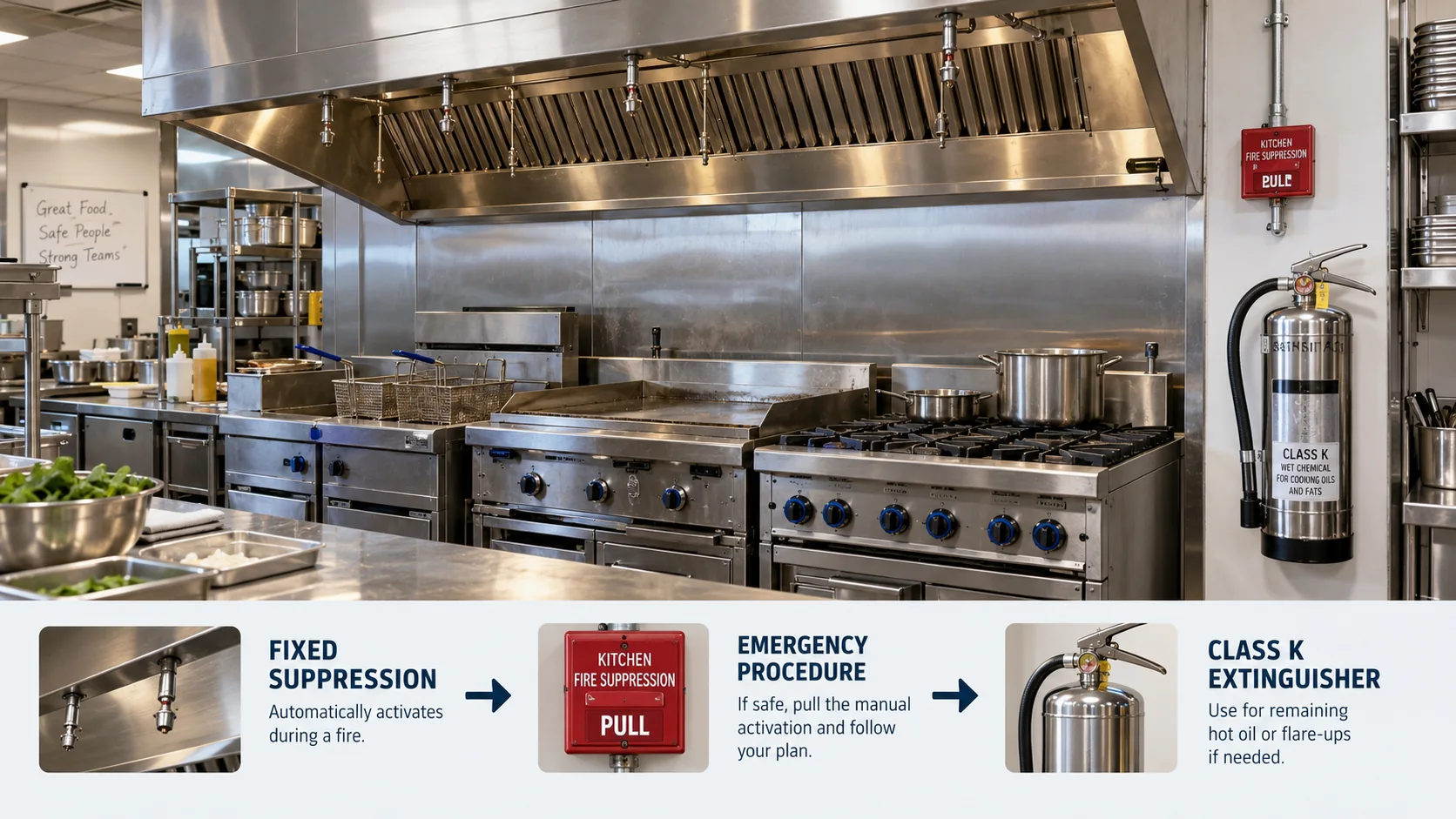
A Class K fire extinguisher is not simply another extinguisher hanging on the kitchen wall.
It is specifically intended for fires involving combustible cooking media such as vegetable oils and animal fats—the high-temperature fuels commonly found in commercial cooking operations.
For restaurant managers, understanding the Class K extinguisher means understanding three things: the cooking hazard it protects, the fixed kitchen suppression system it works alongside, and the emergency procedure employees are expected to follow.
Why Cooking-Oil Fires Are Different
Commercial cooking equipment can heat oil to very high temperatures.
When cooking oil ignites, simply knocking down the visible flames may not eliminate the hazard. The oil can remain extremely hot and may reignite if it is not adequately cooled.
This is one reason commercial cooking hazards are treated differently from many ordinary Class A or Class B fire hazards. Class K extinguishing agents are designed for these high-temperature cooking-oil and grease fires.
A manager should never assume that an extinguisher suitable for ordinary combustibles or another type of flammable-liquid fire is automatically appropriate for a deep fryer or similar cooking-oil hazard.
What Is a Class K Fire Extinguisher Used For?
Class K extinguishers are intended for fires involving combustible cooking oils and fats.
Typical hazards include commercial deep fryers and other cooking equipment where significant quantities of hot cooking media are used.
The extinguisher's label identifies its classification and intended use. Restaurant staff should be trained to recognize the Class K extinguisher and understand that it has a specific role in the kitchen's overall fire-protection strategy.
Class K Does Not Replace the Kitchen Suppression System
Most commercial cooking operations with grease-producing equipment use a fixed fire-suppression system protecting the cooking appliances, hood and exhaust system.
The portable Class K extinguisher works alongside that protection. It should not be treated as a substitute for the fixed system.
Where the appliance is protected by a commercial kitchen suppression system, staff emergency procedures should prioritize the actions established for that system.
OSHA guidance for restaurant employees who are expected to fight a small cooking fire says portable extinguishers should be used only after sounding the alarm, summoning the fire department and activating the fixed fire-suppression system, when it can be done safely and proper training has been provided.
Suppression first. Follow the restaurant’s emergency procedure.
Why Water Is Dangerous on a Cooking-Oil Fire
Water should not be thrown onto a burning deep fryer or other hot cooking-oil fire.
Introducing water into extremely hot or burning oil can violently spread burning material and dramatically worsen the situation.
Employees should never improvise during a cooking-oil fire. The restaurant's emergency procedure should clearly identify the actions staff are expected to take, including evacuation, alarm activation, fixed-system activation and portable extinguisher use where appropriate.
Where Should the Class K Extinguisher Be Located?
A Class K extinguisher needs to be readily accessible.
It should not be buried behind stored supplies, blocked by carts, hidden by equipment or moved to a different part of the restaurant because the wall space was needed for something else.
Applicable codes and standards establish requirements for extinguisher selection and travel distance. OSHA's current eTool, referencing NFPA 10, identifies a maximum 30-foot travel distance for Class K hazards.
Managers do not need to redesign extinguisher placement themselves. They should, however, recognize when an extinguisher has been moved, obstructed or made difficult to reach and arrange appropriate correction.
The Extinguisher Must Match the Hazard
Restaurant kitchens change. A fryer is moved. A new appliance is installed. The menu changes. Cooking equipment is replaced. Production volume increases.
Any significant change to the cooking operation should trigger a question:
Does the existing fire protection still match the cooking hazard?
This applies not only to the Class K extinguisher but also to the commercial kitchen suppression system and exhaust arrangement.
Restaurant managers should involve qualified fire-protection professionals when cooking appliances or protected hazards change. Do not assume protection designed around yesterday's cookline automatically remains appropriate after equipment is rearranged.
What Should Managers Check?
Restaurant managers are not expected to perform professional extinguisher servicing. They should recognize obvious conditions that require attention.
- The Class K extinguisher remains in its designated location.
- It is clearly identifiable and accessible.
- Operating instructions remain legible.
- There is no obvious physical damage, leakage or evidence of discharge.
- The safety seal and pin appear intact where applicable.
- Required inspection and professional service are current under the applicable program.
OSHA requires portable extinguishers covered by its workplace standard to be visually inspected monthly and to receive an annual maintenance check. Local requirements may differ or add additional obligations, so managers should follow the applicable fire code, service requirements and manufacturer instructions.
Do Employees Need Training?
If employees are expected to use portable fire extinguishers, they need appropriate instruction and training.
Knowing that the silver extinguisher near the kitchen is “for grease fires” is not enough. Employees should understand the restaurant's complete emergency procedure.
That includes knowing when to evacuate, how to report the fire, how to activate the building fire alarm where applicable, where the manual kitchen suppression activation device is located and what actions they are authorized and trained to perform.
Training should also reinforce an important limit: employees should not put themselves at unnecessary risk trying to fight a fire.
The Manual Suppression Activation Device Matters Too
Restaurant fire safety should never focus so heavily on the portable extinguisher that staff forget the fixed suppression system.
Employees should know how to identify the manual activation device for the kitchen suppression system and keep access to it clear. Storage, furniture, decorations or equipment should not prevent someone from reaching it.
The activation device should also remain clearly identifiable. Managers should periodically verify that employees who are expected to respond to an emergency know where it is.
What Happens After the Suppression System or Class K Extinguisher Is Used?
The cooking equipment should not simply be cleaned and put back into operation.
After a kitchen suppression-system activation or extinguisher discharge, the affected area should remain out of service until the necessary inspection, servicing and restoration have been completed by qualified personnel.
The cause of the activation or fire should also be determined. The suppression system may require servicing, components may require replacement, the Class K extinguisher may require recharge or replacement, and cooking equipment may require inspection before operation resumes.
Restaurant managers should resist pressure to restart the cookline before the fire-protection systems are ready.
Common Class K Extinguisher Mistakes
Problems often develop through normal restaurant operations rather than deliberate neglect.
- An extinguisher gets blocked by boxes after a delivery.
- Someone moves it during cleaning.
- New equipment changes the cookline but nobody reviews the fire protection.
- Employees know where the Class K extinguisher is but do not know how the fixed suppression system is activated.
- A manager assumes that because the extinguisher has a service tag, nothing needs to be visually checked between contractor visits.
- Staff are told to “use the fire extinguisher” without being taught the full emergency sequence.
Good fire safety connects the equipment to the procedure.
Frequently Asked Questions
What does Class K mean on a fire extinguisher?
Class K identifies an extinguisher intended for fires involving combustible cooking media such as vegetable oils and animal fats used in commercial cooking operations.
Is Class K the same as an ABC extinguisher?
No. ABC extinguishers are designed for different classes of fire. A commercial cooking-oil hazard requires protection appropriate to that hazard, and a restaurant may contain more than one extinguisher type because different hazards exist in the same building.
Can an ABC extinguisher be used on a deep fryer fire?
Employees should follow the restaurant's emergency procedure and use extinguishing equipment specifically appropriate for the hazard. A Class K extinguisher is designed for combustible cooking-oil and fat fires. Do not assume an ABC extinguisher is an acceptable substitute for required Class K protection.
Should the Class K extinguisher be used before the kitchen suppression system?
Where the cooking appliance is protected by a fixed suppression system, the restaurant's emergency procedure should address activation of that system. Fixed suppression should not be bypassed in favour of relying only on a portable extinguisher.
Can you use water on a fryer fire?
No. Water introduced into burning or extremely hot cooking oil can violently spread the fire and create a serious burn hazard.
How often should a Class K extinguisher be checked?
Managers should complete the visual checks required by the applicable program, and professional inspection, maintenance and testing should be completed as required by the applicable code, standard and manufacturer. OSHA's workplace standard requires monthly visual inspection and annual maintenance for covered portable extinguishers.
Class K Is One Part of the Kitchen Fire-Safety System
A restaurant's fire protection should operate as a system.
The hood and duct collect cooking vapours. The exhaust system removes them. Cleaning helps control grease accumulation. The fixed suppression system protects the cooking hazard. Fuel or electrical shutoffs help control energy to the equipment. The Class K extinguisher provides additional portable protection for the cooking-oil hazard.
And trained employees follow the restaurant's emergency procedure when something goes wrong.
Restaurant managers do not need to become fire-protection technicians. They do need to understand how these pieces fit together, recognize obvious problems and know when qualified service is required.
Restaurant Fire Safety Handbook — Coming Soon
The upcoming handbook is being built for restaurant owners, general managers, kitchen managers, supervisors and staff who need practical fire-safety guidance for real restaurant operations.
Authoritative References and Further Reading
The following OSHA resources provide additional background on portable fire extinguishers and restaurant fire hazards:
- OSHA — Portable Fire Extinguishers: Extinguisher Basics
- OSHA — Extinguisher Placement and Spacing
- OSHA — Young Worker Safety in Restaurants: Cooking
Fire-safety requirements vary by jurisdiction, restaurant layout, cooking equipment and installed fire-protection systems. Follow the requirements of the authority having jurisdiction, applicable codes and standards, equipment manufacturers, approved procedures and qualified service professionals.